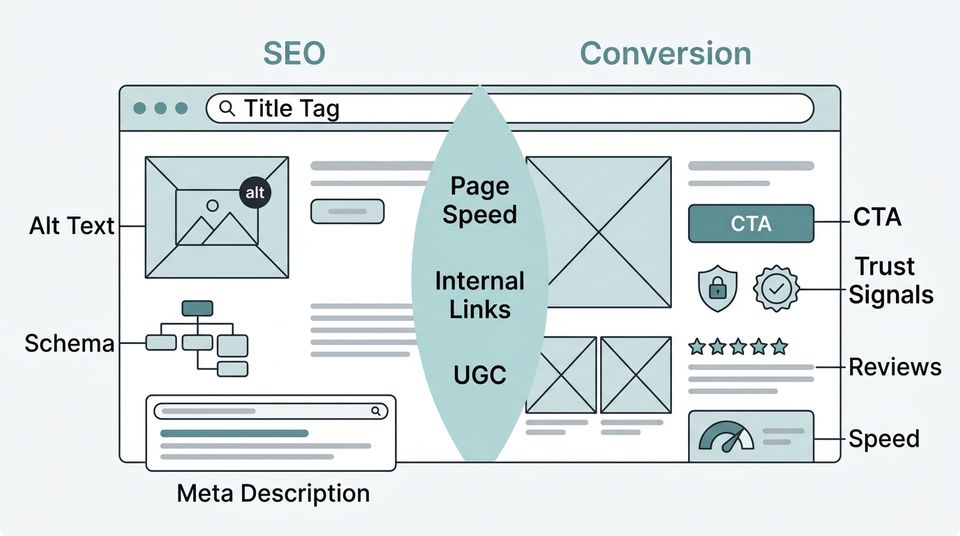
Most ecommerce product pages are optimized for one thing or the other. They rank but do not sell, or they convert but never get found. The product pages that actually grow revenue do both at the same time, and the gap between the two approaches is smaller than most store owners think. Ecommerce product page SEO in 2026 is not about choosing between search visibility and conversion rate. It is about understanding which optimizations serve both purposes and stacking them systematically.
Interconnections has run product page optimization programs for DTC brands where the result was not just more traffic but measurably more revenue. One kids toys brand saw a 202% increase in conversion rate and grew new customers from 699 to 4,941 after a full product page overhaul. Those numbers do not come from title tags alone. They come from treating every element on the page as both a ranking signal and a buying signal.
This guide covers each product page element through that dual lens: what it does for search, what it does for conversion, and how to optimize both without compromise.
Product Title Optimization
Your product title is the single highest-impact on-page SEO element and the first thing a shopper reads. Get the format wrong and you lose both the ranking and the click.
Use the Brand + Product + Key Attribute format. A title like "Patagonia Better Sweater Fleece Jacket, Men's, Navy" tells Google exactly what the product is and tells the shopper they are in the right place. Keep titles under 60 characters so they display fully in search results. Place your primary keyword within the first 3 to 5 words of the title when possible.
Avoid stuffing multiple keywords into the title. A title like "Men's Fleece Jacket Warm Winter Coat Outdoor Hiking Camping Jacket" reads like spam to both Google and buyers. According to Backlinko's analysis of 11.8 million search results, title tag optimization remains one of the strongest on-page ranking correlations, but the effect drops sharply when titles read unnaturally.
For DTC brands selling unique products, include the differentiating attribute in the title. If your product is organic, handmade, or patented, that word belongs in the title because it affects both click-through rate in search and purchase confidence on the page.
Product Descriptions That Rank and Sell
Write a minimum of 200 words of unique product description for every product page. Anything less and Google treats the page as thin content, which makes it nearly impossible to rank for competitive product keywords.
Lead with the primary benefit, not the feature list. A description that opens with "This moisturizer reduces visible fine lines within 14 days" converts better than one that opens with "Contains 2% retinol, hyaluronic acid, and vitamin C." The benefit hooks the reader. The features support the decision. Structure descriptions with the benefit first, then specifications, then use cases.
Every product description must be unique. Copying manufacturer descriptions creates duplicate content that Google has explicitly said it will filter from search results. For stores with hundreds of SKUs, prioritize writing unique descriptions for the top 20% of products by revenue. Those pages drive the most value from both organic traffic and conversion rate improvements.
Include your target keyword naturally within the first 100 words of the description. Use semantic variations throughout: if the primary keyword is "wireless noise cancelling headphones," work in phrases like "Bluetooth headphones with active noise cancellation" and "over-ear wireless headphones" where they fit the copy naturally.
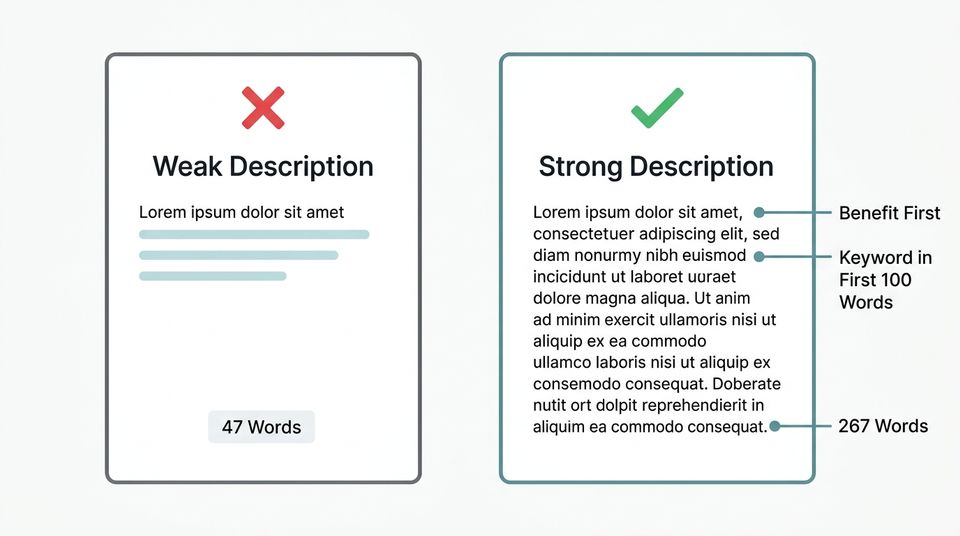
Image Optimization for Search and Speed
Product images are the second most influential conversion element on a product page after price, and they are a meaningful ranking factor through Google Image Search. A study by HTTP Archive found that images account for roughly 50% of the average web page's total weight, making image optimization one of the fastest ways to improve both page speed and Core Web Vitals scores.
Use descriptive file names before uploading. Rename "IMG_4392.jpg" to "patagonia-better-sweater-fleece-jacket-navy-front.webp" so Google can understand the image content from the filename alone. Write alt text that describes what the image literally shows, not marketing copy. "Navy blue Patagonia Better Sweater fleece jacket shown on a male model, front view" is correct alt text. "Best fleece jacket for men" is keyword stuffing.
Convert all product images to WebP format. WebP delivers 25 to 34% smaller file sizes than JPEG at equivalent quality, according to Google's WebP documentation. Compress images to under 200KB per file where possible. Use responsive images with srcset attributes so mobile devices load smaller versions.
For DTC brands, include at least 5 product images: front, back, detail, lifestyle, and scale. More images correlate with higher conversion rates because they reduce purchase uncertainty. Each additional image is also an additional indexable asset in Google Image Search.
Product Schema Markup in 2026
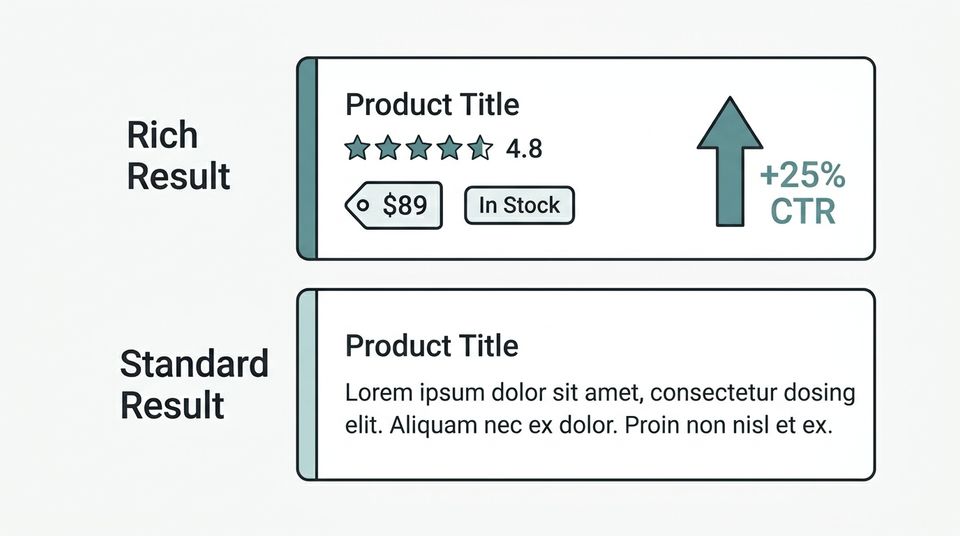
Product schema markup tells search engines exactly what your product page contains: price, availability, reviews, brand, and condition. Pages with proper Product structured data are eligible for rich results in Google, which display star ratings, price, and availability directly in search listings.
In 2026, Google expanded support for product variant structured data using the Schema.org ProductGroup type. This means a single parent product can now declare its variants (sizes, colors, materials) as structured data, and Google can surface the specific variant that matches the search query. If you sell a product in 12 colors, each color variant should be declared in your schema.
The minimum required Product schema fields are: name, image, description, brand, offers (including price, priceCurrency, and availability). Add aggregateRating if you have reviews and review if you have individual review data. According to Search Engine Journal, Google confirmed in early 2026 that structured data remains a core part of how it processes and displays product information, despite retiring some other schema types.
Schema markup does not directly improve rankings, but rich results dramatically improve click-through rate. Pages with product rich results in Google Shopping typically see 20 to 30% higher CTR than standard blue links for the same query. That additional traffic, combined with the trust signal of visible ratings and pricing, compounds into both more visitors and higher conversion rates.
Internal Linking Strategy for Product Pages
Internal links from product pages serve two distinct purposes: they help Google discover and prioritize your pages for crawling, and they guide shoppers toward related products that increase average order value. Most ecommerce stores treat internal linking as a navigation problem. It is actually a revenue problem.
Start with category breadcrumbs. Every product page should display a breadcrumb trail (Home > Category > Subcategory > Product) that is marked up with BreadcrumbList schema. Breadcrumbs help Google understand your site hierarchy and give shoppers a clear path to browse related products.
Add contextual links within product descriptions to related buying guides, comparison pages, or category pages. A product page for a running shoe should link to your "How to Choose Running Shoes" guide and your "Men's Running Shoes" category page. These links pass authority to your informational content while helping shoppers who need more information before buying.
Related product recommendations at the bottom of each product page are both a conversion tool and an internal linking mechanism. Interconnections has seen this strategy contribute to measurable conversion lifts when implemented alongside broader product page optimization. The key is relevance: recommend products in the same category or that solve the same problem, not random cross-sells.
Link from blog content back to product pages using descriptive anchor text. If you write a blog post about skincare routines, link the product names to their respective product pages. This two-way linking pattern builds topical authority around your product categories and gives Google clear signals about which pages are most important.
User-Generated Content as an SEO Engine
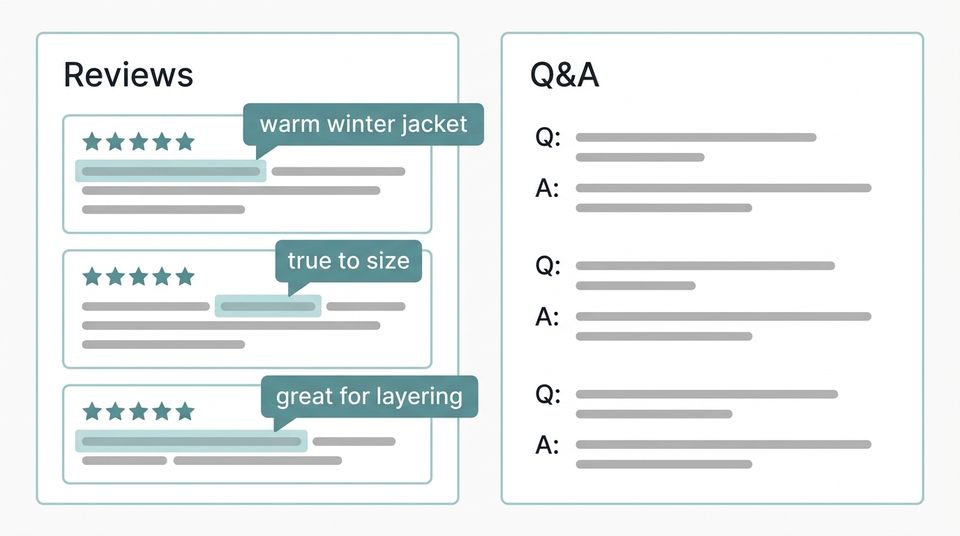
Product reviews are indexable content that grows your page automatically. Every review a customer leaves adds unique, keyword-rich text to your product page without any effort from your team. This is one of the few SEO strategies that compounds over time with zero ongoing production cost.
Reviews naturally contain the long-tail keywords your customers use to describe your products. A customer reviewing a jacket might write "keeps me warm during Chicago winters" or "perfect for layering under a parka." Those phrases match real search queries that your product description would never include. According to Bazaarvoice research, products with reviews see 128% higher conversion rate than products without, and pages with 50 or more reviews see significant organic traffic increases from long-tail queries.
Add a Q&A section to your product pages. Answered product questions serve the same dual purpose as reviews: they add indexable content to the page and they reduce purchase friction for future shoppers. Questions like "Does this run true to size?" or "Is this compatible with X?" are exactly the queries people type into Google.
Mark up reviews with Review schema and aggregate ratings with AggregateRating schema. This enables star rating display in search results, which is one of the most powerful click-through rate signals in ecommerce search. The combination of visible ratings in the SERP and detailed reviews on the page creates a ranking-to-conversion pipeline that feeds itself.
Mobile Product Page Optimization
More than 60% of ecommerce traffic comes from mobile devices, but mobile conversion rates consistently trail desktop by 15 to 20%. The product page optimization gap on mobile represents one of the largest revenue opportunities for DTC brands running paid traffic to product pages.
Google replaced First Input Delay (FID) with Interaction to Next Paint (INP) as a Core Web Vital in March 2024. INP measures the responsiveness of every interaction on the page, not just the first one. For product pages, this means your image gallery swipes, size selector taps, and add-to-cart button presses all affect your Core Web Vitals score. A one-second delay in mobile load time can reduce conversions by up to 20%, which makes mobile page performance both a ranking factor and a direct revenue lever.
Optimize touch targets for mobile product pages. Size selectors, color swatches, and the add-to-cart button should be at least 48x48 pixels with 8 pixels of spacing between targets. Place the add-to-cart button within the thumb zone (the lower third of the screen) so it is reachable without stretching. Sticky add-to-cart bars that follow the user as they scroll remove the need to scroll back up after reading the description.
Compress above-the-fold content aggressively on mobile. The product image, title, price, and add-to-cart button should load within 2.5 seconds on a 4G connection. Defer loading of reviews, related products, and below-the-fold images until the user scrolls to them. Lazy loading these elements improves both Largest Contentful Paint (LCP) and the user's perception of page speed.
CRO Elements That Also Improve Rankings
Page speed is the clearest example of a metric that serves both Google and your customers. Google uses Core Web Vitals (LCP, INP, CLS) as ranking signals, and faster pages convert at higher rates. Improving LCP from 4 seconds to under 2.5 seconds typically improves both your search position and your conversion rate simultaneously.
Clear, prominent CTAs reduce bounce rate and increase time on page, both of which are engagement signals Google measures. A product page where the add-to-cart button is buried below the fold will have higher bounce rates than one where the CTA is visible immediately. That bounce rate affects your rankings through Google's user experience signals.
Trust signals (security badges, return policy, shipping information, and payment icons displayed near the CTA) reduce purchase hesitation and improve dwell time. Shoppers who feel confident stay on the page longer and engage with more content, which sends positive engagement signals back to Google. Interconnections found that a lifestyle brand's landing page CVR improved 35% after optimizing trust signals and page layout, and that a computer accessories brand saw its ROAS jump from 0.6 to 2.5 (a 3.5x improvement) after product page conversion optimization that included trust signal placement.
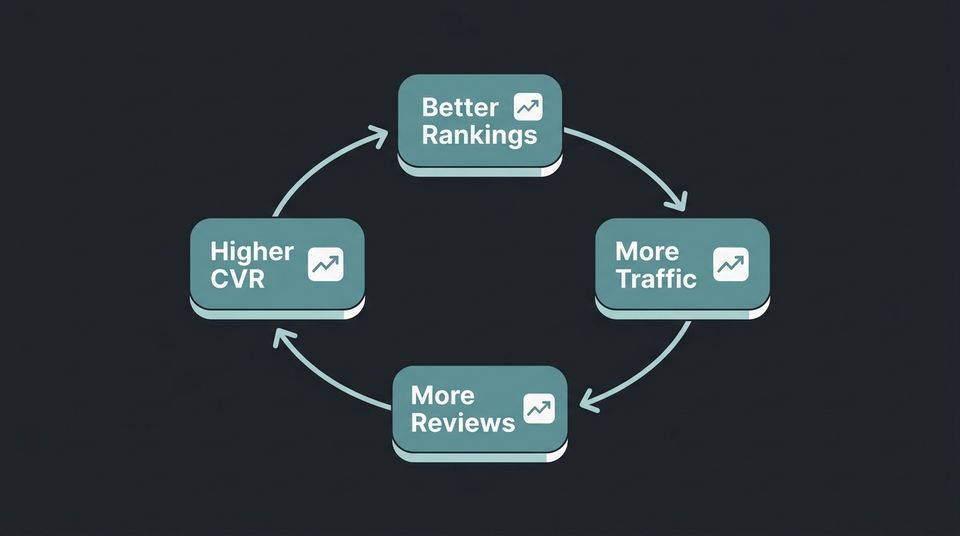
Structured data and rich results create a feedback loop. Schema markup earns you rich results in search, which improves CTR. Higher CTR sends engagement signals to Google, which can improve rankings. Better rankings drive more traffic, which means more reviews, which means more indexable content and higher conversion rates. Interconnections builds this feedback loop into every ecommerce SEO engagement because the compounding effect is where the real growth happens.
The Product Page SEO Audit in Four Steps
Run this structured audit to identify the highest-impact opportunities on your product pages before optimizing individual elements.
Crawl and Index Audit
Use Google Search Console to check how many product pages are indexed versus how many exist. If less than 80% are indexed, fix crawl or canonicalization issues before any on-page work. Check for duplicates from variants, filtered URLs, and pagination.
On-Page Content Audit
Evaluate titles, descriptions, and image alt text across your top 50 revenue-generating product pages. Flag pages with fewer than 200 words of unique description, missing alt text, or titles not in Brand + Product + Attribute format.
Technical Performance Audit
Run Core Web Vitals via PageSpeed Insights on desktop and mobile for top product pages. Flag any page with LCP above 2.5 seconds, INP above 200 milliseconds, or CLS above 0.1. These suppress both rankings and conversion rates.
Schema and Structured Data Audit
Validate Product schema using Google Rich Results Test. Confirm price, availability, brand, and aggregate rating are present and accurate. Check whether product variants use the new ProductGroup schema type.
An arts and crafts brand Interconnections worked with saw organic traffic increase 410% after addressing crawl issues (1,442 fixed), improving site health from 67% to 92%, and optimizing product page content and schema. The audit identified the problems. The structured approach to fixing them produced the results.
Frequently Asked Questions
How many words should an ecommerce product description be for SEO?
Write a minimum of 200 words of unique product description per page. Interconnections recommends 250 to 400 words for competitive product categories, with the primary keyword in the first 100 words and benefit-led copy that addresses the buyer's decision criteria. Pages with thin descriptions under 100 words are routinely filtered by Google as low-value content.
Does product schema markup directly improve rankings?
Product schema markup does not directly boost rankings, but it enables rich results (star ratings, price, availability) in Google search listings. Interconnections has seen rich results improve click-through rates by 20 to 30% compared to standard listings, and that increased CTR sends positive engagement signals that can indirectly improve rankings over time.
How do you write unique descriptions when selling the same products as competitors?
Focus on your customer's use case rather than the product specifications. Interconnections advises writing descriptions that address how your target customer uses the product, what problem it solves for them, and what makes the buying experience different. This approach produces naturally unique content even for commodity products.
What is a good conversion rate for an ecommerce product page?
The global average ecommerce product page conversion rate is 2.0 to 2.5%. Interconnections considers 3.2% or higher to be strong performance, which places a store in the top 20% of ecommerce sites. Desktop pages convert at approximately 3.2% versus mobile at 2.8%, so optimizing the mobile experience is often the fastest path to improvement.
Should product pages or category pages be the SEO priority?
Both serve different roles. Category pages rank for high-volume commercial keywords while product pages rank for specific long-tail queries. Interconnections recommends starting with your top 20 revenue-generating product pages because they have the highest immediate ROI from optimization, then expanding to category pages for broader keyword coverage.
How does AI search affect product page SEO in 2026?
AI search engines like Google AI Overviews and ChatGPT shopping pull structured product data when generating responses. Interconnections treats AI search readiness as part of every product page optimization because product pages with complete schema markup, detailed descriptions, and review content are more likely to be cited in AI-generated shopping answers.
Start With an Audit, Not a Redesign
Most product page problems are structural, not visual. If your product pages are not ranking or not converting, the fix is usually in the content, schema, and technical performance rather than the design. The four-step audit above identifies exactly where the gaps are before you spend anything on changes.
If you are running a DTC brand between $1M and $10M and your product pages are getting traffic but not converting, or converting but not getting found, the next step is a full diagnostic that maps the 12 product page elements that actually move conversion rate against your current performance data. Understanding how a CVR improvement directly reduces your CAC is what turns product page optimization from a marketing project into a growth lever. If you are unsure where to start, knowing how to evaluate an ecommerce marketing agency before signing will help you find a partner who treats product pages as revenue drivers, not checkboxes. That diagnostic is exactly what the Interconnections Growth Diagnostic Sprint covers.